


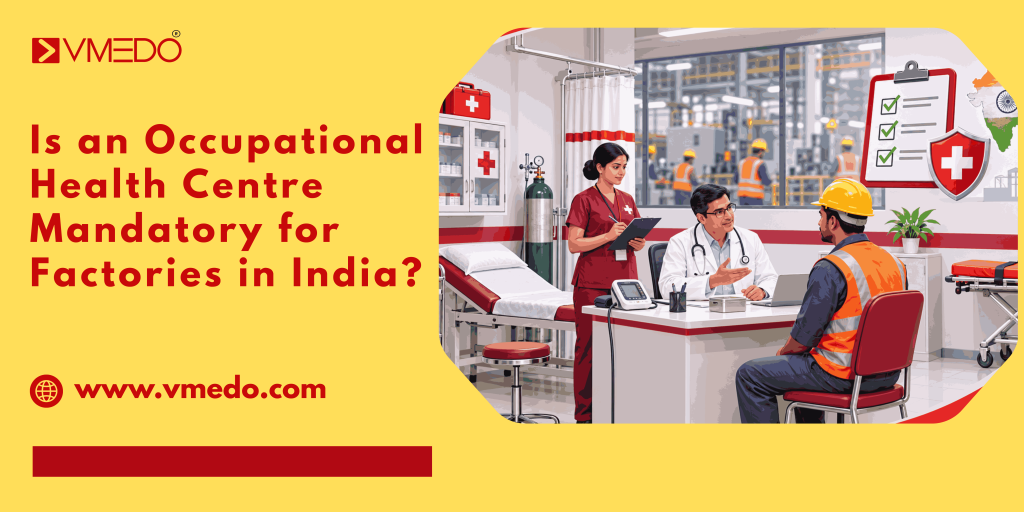
An Occupational Health Centre (OHC) plays an important role in maintaining employee health, managing workplace medical emergencies and preventing occupational diseases. However, many factory owners, HR managers and EHS professionals have a common question: Is an Occupational Health Centre mandatory for factories in India?
The answer depends on factors such as the number of workers, the nature of manufacturing activities, workplace hazards and applicable occupational health and safety regulations.
Under India’s Occupational Safety, Health and Working Conditions (OSHWC) Code, 2020, employers must meet prescribed workplace health and welfare requirements. Additionally, applicable State rules may specify when factories must establish an Occupational Health Centre and appoint medical personnel.
What Is an Occupational Health Centre (OHC)?
An Occupational Health Centre is a designated medical facility within a factory or industrial establishment that provides occupational healthcare, first aid, medical surveillance and emergency medical assistance to employees.
Depending on the factory’s requirements, an OHC may provide:
- First aid and emergency medical care.
- Pre-employment and periodic medical examinations.
- Occupational disease monitoring and prevention.
- Medical consultations and employee health assessments.
- Maintenance of employee medical and occupational health records.
- Emergency stabilisation and referral to hospitals.
An OHC supports workplace health and safety while helping employers meet applicable statutory obligations.
Is an Occupational Health Centre Mandatory Under Indian Law?
Yes, an Occupational Health Centre is mandatory for factories covered by specific legal requirements. However, a dedicated OHC is not compulsory for every factory in India.
The legal framework includes the following provisions.
1. Occupational Safety, Health and Working Conditions Code, 2020
The OSHWC Code came into force on 21 November 2025, replacing the Factories Act, 1948, as part of India’s labour-law reforms.
Section 24 addresses workplace welfare facilities, including first-aid arrangements.
Furthermore, Section 24(2)(i) provides for ambulance-room requirements in factories and certain other establishments ordinarily employing more than 500 workers, subject to the applicable rules.
The Occupational Safety, Health and Working Conditions (Central) Rules, 2026, further specify ambulance-room facilities under Rule 55 for establishments within their scope.
However, an ambulance room and an Occupational Health Centre are not necessarily identical statutory facilities. Additional requirements may apply to factories carrying out hazardous processes.
2. State-Specific Factory Rules
In addition to the central framework, factories must consider applicable State rules, including provisions preserved during the transition to the OSHWC Code.
For example, Karnataka’s earlier Factories Rules, 1969, contain specific Occupational Health Centre requirements for factories carrying out hazardous processes.
Consequently, employers should not assume that the same employee threshold or OHC staffing requirement applies to every factory across India.
How Many Employees Are Required for an Occupational Health Centre?
The number of employees is an important factor in determining OHC requirements. However, the applicable threshold also depends on the factory’s operations and State regulations.
For example, Rule 88-M of the Karnataka Factories Rules, 1969, provides the following framework for factories carrying out hazardous processes, subject to its continued applicability under the OSHWC Code.
| Number of Workers | Occupational Health Requirements |
|---|---|
| Up to 50 workers | Factory Medical Officer on a retainership basis, trained first-aid personnel and a fully equipped first-aid box. |
| 51–200 workers | Dedicated OHC room, part-time Factory Medical Officer visiting at least twice a week and qualified medical support personnel. |
| Above 200 workers | OHC with at least two rooms, full-time Factory Medical Officer and prescribed nursing and support staff. |
These requirements relate specifically to hazardous-process factories under the Karnataka framework and should not be treated as nationwide thresholds.
Important: Karnataka published draft OSHWC Rules, 2026, containing similar OHC provisions under proposed Rule 93. These draft provisions should not be treated as final enforceable rules unless officially notified. Employers must verify the applicable final and saved rules before making compliance decisions.
Is an OHC Mandatory for Factories Involved in Hazardous Processes?
Factories carrying out hazardous processes may be subject to stricter occupational health requirements because employees can face increased exposure to workplace risks.
Such risks may arise in industries involving:
- Chemical manufacturing and processing.
- Paints, coatings and chemical handling.
- Metal processing and foundries.
- Petroleum and petrochemical operations.
- Certain pharmaceutical manufacturing processes.
- Other operations involving harmful dust, fumes, gases or hazardous substances.
However, an industry’s name alone does not determine its legal classification. The actual manufacturing process and relevant statutory schedules must be examined.
For factories covered by hazardous-process OHC rules, medical facilities and staffing requirements may increase with workforce strength.
What Facilities Should an Occupational Health Centre Have?
The equipment and infrastructure required for an OHC depend on applicable legal provisions, the number of workers and workplace health risks.
A typical Occupational Health Centre may include the following facilities.
1. Medical Infrastructure
- Examination bed and patient observation area.
- Doctor’s consultation table and chair.
- Medical storage cabinets.
- Handwashing and sanitation facilities.
- Appropriate lighting, ventilation and privacy.
2. Emergency Medical Equipment
- First aid kits and emergency medical supplies.
- Blood pressure monitor and stethoscope.
- Pulse oximeter and thermometer.
- Oxygen cylinder and accessories.
- Stretcher and wheelchair.
- Automated External Defibrillator (AED), where appropriate.
3. Occupational Health Equipment
Depending on workplace exposure risks, additional equipment may include:
- ECG machine.
- Spirometer for pulmonary function testing.
- Audiometer for hearing assessment.
- Vision screening equipment.
- Blood glucose monitoring equipment.
Employers should determine the final equipment list based on applicable statutory schedules, occupational risk assessments and medical requirements.
Is a Factory Medical Officer Mandatory for an OHC?
A Factory Medical Officer (FMO) may be mandatory where applicable OHC rules prescribe medical staffing.
The requirement can vary based on workforce strength, the nature of hazardous operations and State-specific regulations.
Depending on the applicable rules, factories may need:
- A medical officer on a retainership basis.
- A part-time Factory Medical Officer.
- A full-time Factory Medical Officer.
- Qualified nurses and other medical support personnel.
Some provisions also require medical officers to possess recognised qualifications or training in industrial health, such as AFIH or an equivalent recognised qualification.
Therefore, employers should verify the prescribed qualifications and staffing arrangements before appointing OHC medical personnel.
Is an OHC Different from a First Aid Room?
Yes. Although both support workplace medical safety, they serve different purposes.
| First Aid Room | Occupational Health Centre |
|---|---|
| Primarily supports immediate first aid. | Provides broader occupational healthcare services. |
| Focuses on initial treatment of injuries and emergencies. | May support medical examinations, surveillance and emergency treatment. |
| May have basic first aid equipment. | May require additional diagnostic and medical equipment. |
| Staffing depends on applicable first aid rules. | May require a Factory Medical Officer, nurse and support personnel. |
A first aid room cannot automatically replace a legally prescribed Occupational Health Centre.
Similarly, a factory should not assume that providing an ambulance or maintaining a hospital tie-up removes its obligation to establish an OHC where one is required.
What Should Factories Check for OHC Compliance?
Factory owners, HR managers and EHS professionals should review the following requirements before establishing or upgrading an Occupational Health Centre.
- Workforce strength: Determine the applicable worker count, including how relevant rules treat contract labour.
- Hazardous-process classification: Identify whether any manufacturing activity falls under a legally defined hazardous process.
- Applicable regulations: Review the OSHWC Code and current Central or State rules.
- Medical staffing: Verify Factory Medical Officer, nurse and other staffing requirements.
- Infrastructure: Provide the prescribed medical rooms, equipment and facilities.
- Medical surveillance: Conduct required medical examinations and maintain occupational health records.
- Emergency preparedness: Establish appropriate first aid, ambulance and hospital referral arrangements.
Regular compliance reviews can help factories identify gaps in medical infrastructure, staffing and emergency preparedness.
Frequently Asked Questions (FAQs)
1. Is an Occupational Health Centre compulsory for every factory in India?
No. A dedicated OHC is not universally mandatory for every factory. The requirement depends on applicable regulations, hazardous processes, workforce strength and State-specific provisions.
2. Is an OHC mandatory for factories with fewer than 50 employees?
Not necessarily. Smaller factories may still need prescribed medical services and first aid arrangements. In Karnataka’s hazardous-process framework, factories with up to 50 workers require specified medical-officer access and first aid facilities rather than the same dedicated OHC infrastructure prescribed for larger factories.
3. Is an OHC mandatory for factories with more than 200 workers?
It depends on the applicable State rules and the factory’s operations. For example, Karnataka’s hazardous-process framework prescribes a dedicated OHC with full-time medical staffing for factories employing more than 200 workers.
4. Is an ambulance room mandatory for factories employing more than 500 workers?
Section 24 of the OSHWC Code provides the framework for this requirement, while Rule 55 of the Central Rules, 2026, prescribes ambulance-room or dispensary arrangements for covered establishments ordinarily employing more than 500 workers. State-specific requirements must also be checked.
5. Can a factory outsource OHC staffing services?
Factories may engage qualified external healthcare service providers to support OHC operations, subject to applicable legal requirements. However, outsourcing does not automatically transfer the factory employer’s statutory responsibilities to the service provider.
An Occupational Health Centre is mandatory for factories that fall within the relevant statutory requirements, particularly certain factories carrying out hazardous processes. However, OHC obligations differ based on workforce strength, industrial activities and applicable Central and State regulations.
Therefore, factory owners, HR managers and EHS professionals should evaluate their occupational health requirements before establishing medical facilities or appointing medical staff.
Maintaining suitable occupational healthcare infrastructure not only supports regulatory compliance but also helps protect employee health and strengthen workplace emergency preparedness.
VMEDO Healthcare supports industries with Occupational Health Centre setup, qualified medical staffing, medical equipment, employee health examinations and workplace emergency healthcare solutions.
VMEDO – Occupational Health & Wellness Experts!
Legal References
- Occupational Safety, Health and Working Conditions Code, 2020 – Sections 23, 24 and 143.
- OSHWC (Central) Rules, 2026 – Rules 54 and 55 relating to first aid and ambulance-room facilities.
- Karnataka Factories Rules, 1969 – Rule 88-M concerning Occupational Health Centres for hazardous-process factories, subject to applicable savings provisions.
- Draft OSHWC (Karnataka) Rules, 2026 – Proposed Rule 93 concerning Occupational Health Centres; verify final notification status.
Note: Legal requirements may change through notifications, amendments and State-specific rules. Factories should confirm the current applicable provisions with the relevant regulatory authority.