


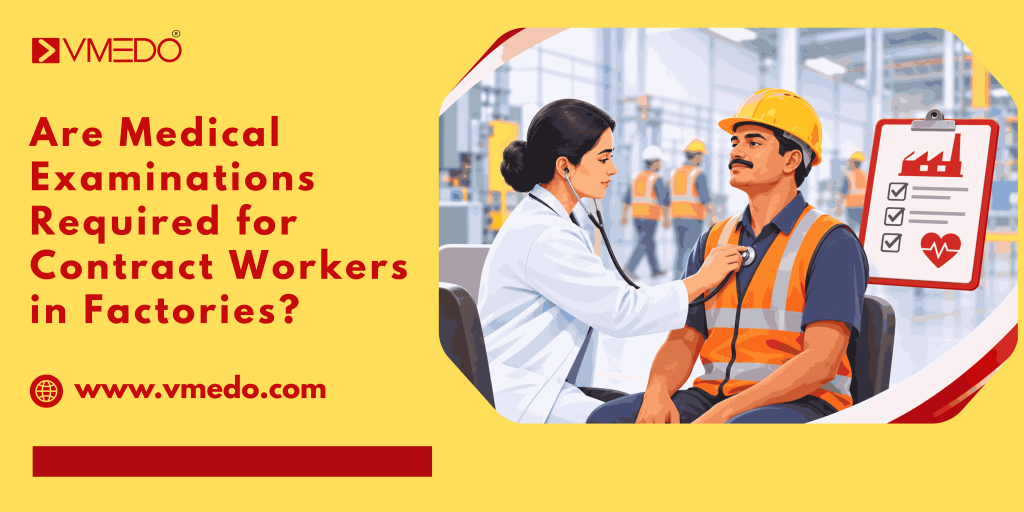
Factories often employ contract workers for manufacturing, maintenance, housekeeping, material handling and other operational activities. While these workers may receive their wages through contractors, they often work in the same environments and face similar occupational health risks as permanent employees.
This raises an important question for factory management and HR professionals: Are medical examinations required for contract workers in factories?
The answer is yes, where applicable occupational health regulations require them. However, the specific requirements depend on the nature of work, workplace hazards, age-related provisions and applicable government rules.
Understanding these requirements helps factories protect worker health, maintain medical records and fulfil their occupational safety responsibilities.
Are Medical Examinations Mandatory for Contract Workers?
Medical examinations may be mandatory for contract workers depending on their job responsibilities and occupational exposure.
For example, contract workers handling hazardous chemicals may require medical examinations before starting work and periodically during employment. Similarly, workers performing certain dangerous operations may need additional medical fitness assessments.
However, not every contract worker automatically requires the same medical tests or examination frequency.
Under the Occupational Safety, Health and Working Conditions Code, 2020 (OSHWC Code), employers have specific responsibilities concerning workplace health, safety and medical examinations.
The Code came into effect on 21 November 2025, replacing the Factories Act, 1948, and several other central labour laws.
What Does the OSHWC Code, 2020 Say About Contract Worker Medical Examinations?
The OSHWC Code establishes a legal framework for protecting workers, including contract workers, from occupational hazards.
Several provisions are particularly relevant to medical examinations.
1. Section 6 – Duties of Employers
Section 6 requires employers to maintain safe working environments and provide prescribed health examinations to eligible employees without charging them.
It also prohibits charging employees for workplace health and safety measures, including medical examinations conducted to detect occupational diseases.
The annual health examination provision applies according to the age groups, employee categories and establishments prescribed by the appropriate government.
2. Section 82 – Dangerous Operations
Section 82 enables the appropriate government to prescribe safety requirements for manufacturing processes involving serious risks of injury, poisoning or occupational disease.
These requirements may include medical examinations before employment or during employment to determine a worker’s medical fitness.
Consequently, contract workers performing such operations may need medical examinations based on the applicable rules.
3. Section 85 – Hazardous Processes
Section 85 establishes specific responsibilities for factories involving hazardous processes.
It requires medical examinations of workers before assignment to jobs involving hazardous substances and during or after such employment, at prescribed intervals not exceeding 12 months.
Therefore, contract workers exposed to hazardous substances cannot be excluded from applicable medical surveillance requirements merely because a contractor employs them.
Do Contract Workers and Permanent Employees Have the Same Medical Examination Requirements?
The medical examination requirements primarily depend on the worker’s occupational exposure and applicable legal provisions rather than employment classification alone.
For instance, if a permanent employee and a contract worker perform similar jobs involving exposure to hazardous chemicals, both may require comparable occupational medical surveillance.
However, workers assigned to low-risk administrative activities may not require the same examinations as those handling hazardous materials.
Factories should therefore evaluate occupational risks before determining the appropriate medical examination programme.
What Types of Medical Examinations Should Contract Workers Undergo?
The required medical examinations depend on the worker’s job role, exposure to hazards and applicable occupational health regulations.
1. Pre-Employment Medical Examination
A pre-employment medical examination assesses a worker’s fitness before assignment to a particular job.
Depending on the role, the assessment may include a general physical examination, vision assessment, respiratory evaluation and other relevant tests.
For certain hazardous processes, pre-assignment medical examinations are a statutory requirement.
2. Periodic Medical Examination
Periodic medical examinations help monitor workers who face ongoing occupational health risks.
These examinations can help identify changes in health associated with prolonged exposure to workplace hazards.
The frequency depends on the applicable rules and specific occupational risks.
3. Hazard-Specific Medical Examination
Workers exposed to specific occupational hazards may require additional examinations.
For example:
| Occupational Exposure | Possible Medical Assessments |
|---|---|
| High noise levels | Audiometry |
| Dust and respiratory hazards | Pulmonary Function Test (PFT) |
| Chemical exposure | Relevant blood tests and exposure-specific assessments |
| Visually demanding operations | Vision examination |
| Physically demanding work | Physical fitness and musculoskeletal assessment |
These are illustrative assessments. The Factory Medical Officer should determine the appropriate tests based on occupational exposure and applicable regulations.
Who Is Responsible for Contract Worker Medical Examinations?
Both factory management and contractors have important responsibilities in protecting contract workers’ occupational health.
Under the OSHWC Code, the principal employer has responsibilities for workplace health and welfare facilities provided to contract workers.
Responsibilities of Factory Management
Factory management should:
- Identify occupational health risks associated with contract workers’ activities.
- Ensure applicable medical examinations are conducted.
- Coordinate examinations with contractors and occupational health professionals.
- Maintain required fitness certificates and occupational health records.
- Monitor compliance with relevant medical examination requirements.
Responsibilities of Contractors
Contractors should coordinate with factory management to ensure that their workers meet applicable medical fitness requirements.
This includes providing accurate workforce information, facilitating medical appointments and following up on relevant fitness recommendations.
The precise allocation of responsibilities should reflect applicable law and contractual arrangements, without excluding the factory occupier’s statutory obligations.
Are Annual Medical Examinations Required for Contract Workers Above 40 Years?
The OSHWC Code provides for free annual health examinations for employees in prescribed categories.
Workers aged 40 years and above are an important group under this preventive healthcare framework. However, specific implementation requirements depend on the rules applicable to the establishment.
Importantly, workers below 40 years are not automatically exempt from medical examinations.
Workers engaged in hazardous processes and dangerous operations may require pre-employment and periodic medical examinations irrespective of age.
Medical Examination Requirements for Contract Workers in Karnataka
Factories operating in Karnataka must consider the OSHWC Code alongside applicable state rules and requirements preserved during the transition from the Factories Act.
Under Rule 88-L of the Karnataka Factories Rules, 1969, medical examination requirements for workers engaged in hazardous processes included:
- Medical examination before employment.
- Periodic medical examinations once every six months, or more frequently where medically necessary.
- Maintenance of prescribed health records and fitness certification.
These requirements must be considered alongside the OSHWC Code’s repeal-and-savings provisions and any subsequently notified state rules.
Karnataka published draft OSHWC Rules, 2026, on 23 January 2026. The draft includes annual health examinations for workers aged 40 and above. However, factories should verify the latest notified state rules and applicable examination intervals before establishing their compliance programme.
How Can Factories Ensure Medical Examination Compliance for Contract Workers?
Factory management, HR departments and EHS professionals can follow a structured process to manage contract worker medical examinations.
Step 1: Identify Contract Workers
Maintain an updated list of contract workers, including their assigned departments, job responsibilities and contractors.
Step 2: Assess Occupational Health Risks
Identify workers exposed to noise, dust, chemicals, physical hazards or other occupational risks.
Step 3: Determine Applicable Medical Examinations
Coordinate with qualified occupational health professionals to identify the medical tests required under applicable rules.
Step 4: Conduct Medical Examinations
Arrange pre-employment, periodic and other required examinations according to the worker’s occupational exposure.
Step 5: Maintain Medical Records
Maintain prescribed health registers, medical fitness certificates and examination schedules while protecting confidential medical information.
Step 6: Monitor and Follow Up
Track medical examination due dates and ensure workers receive appropriate medical follow-up when necessary.
A structured approach helps factories maintain occupational health standards while reducing gaps in compliance documentation.
Frequently Asked Questions (FAQs)
1. Are medical examinations compulsory for all contract workers in factories?
Not necessarily. Medical examinations are compulsory where applicable laws and rules require them, particularly for workers involved in hazardous processes or dangerous operations. Other requirements may apply based on age, job responsibilities and occupational exposure.
2. Who should pay for contract worker medical examinations?
Medical examinations required under workplace occupational health and safety provisions should be provided without charging the worker, in accordance with Section 6 of the OSHWC Code.
3. How often should contract workers undergo medical examinations?
The frequency depends on the applicable regulations and occupational risks. Certain hazardous processes may require examinations every six months, while other legal provisions prescribe different intervals.
4. Do temporary contract workers also require medical fitness certificates?
Temporary contract workers may require medical fitness certification if their assigned duties fall within activities for which such certification is mandatory. Short employment duration does not automatically remove applicable occupational health requirements.
5. Can contract workers be excluded from factory medical examination programmes?
Contract workers should not be excluded solely because of their employment status. Factories must assess whether applicable occupational health regulations cover the activities performed by these workers.
Medical examinations play an important role in protecting contract workers from occupational health hazards.
Although examination requirements vary depending on job roles, workplace exposures and applicable regulations, factories must ensure that eligible contract workers receive the medical assessments required by law.
Therefore, HR managers, EHS professionals and factory management should establish a structured occupational health programme covering both permanent and contract workers wherever applicable.
Ultimately, ensuring appropriate medical examinations for contract workers helps factories strengthen occupational health compliance and create safer working environments.
VMEDO – Occupational Health & Wellness Expert!
Legal References and Official Resources
For further information on contract worker medical examination requirements, refer to:
- OSHWC Code, 2020 – Sections 6, 82 and 85 covering occupational health and medical examination requirements.
- Karnataka Factories Rules, 1969 – Rule 88-L covering medical examinations for hazardous processes, subject to continuing applicability.
- Karnataka OSHWC Draft Rules, 2026 – Proposed state-specific occupational health and medical examination provisions.
Disclaimer: This article is for informational purposes only. Employers should verify the latest applicable laws, notified rules and government guidelines before implementing medical examination requirements.