


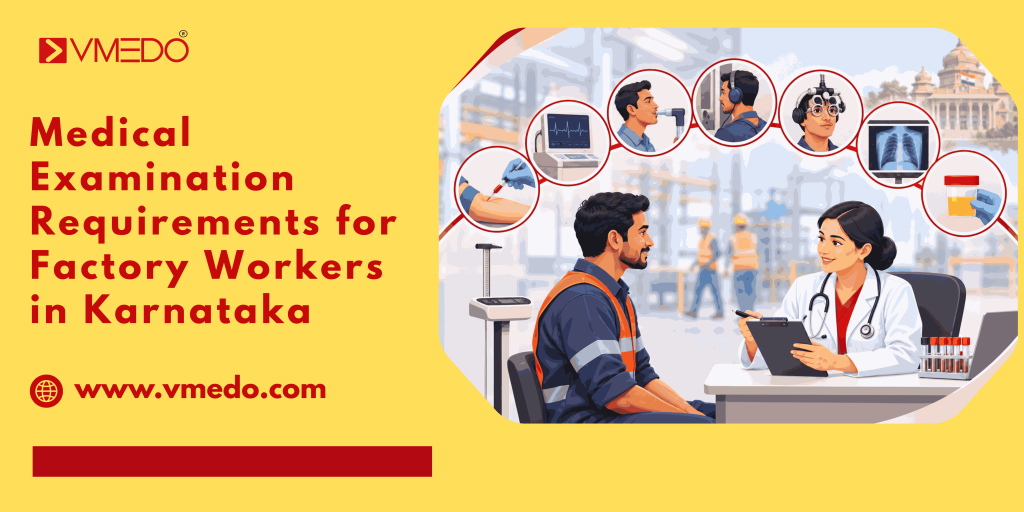
Employee health is an essential part of workplace safety, particularly in factories where workers face exposure to dust, chemicals, noise, heat and other occupational hazards. Therefore, conducting appropriate medical examinations helps employers identify work-related health risks, assess employees’ fitness for their assigned duties and maintain occupational health compliance.
In Karnataka, factory medical examinations have traditionally been regulated by the Factories Act, 1948, and the Karnataka Factories Rules, 1969.
However, with the implementation of the Occupational Safety, Health and Working Conditions (OSHWC) Code, 2020, employers must also consider the updated national legal framework and applicable Karnataka state rules.
This article explains the medical examination requirements for factory workers in Karnataka, including examination frequency, statutory records, medical tests and the responsibilities of factory management.
What Are the Medical Examination Requirements Under the Factories Act, 1948?
The Factories Act, 1948, established occupational health and safety requirements for workers employed in manufacturing establishments.
Two important provisions relating to medical examinations were:
Section 41C – Responsibilities of Occupiers in Hazardous Processes
Section 41C required factory occupiers carrying out hazardous processes to arrange medical examinations for workers before assigning them to jobs involving hazardous substances.
Additionally, it provided for medical surveillance during employment and after workers ceased performing such jobs, at prescribed intervals not exceeding 12 months.
Section 87 – Dangerous Operations
Section 87 empowered state governments to introduce additional safety requirements for manufacturing operations involving serious risks of injury, poisoning or occupational disease.
These requirements could include medical examinations, fitness certification and restrictions on employing medically unfit workers in specified operations.
In Karnataka, the Karnataka Factories Rules, 1969, provided more detailed requirements for implementing these provisions.
Important regulatory update: The OSHWC Code, 2020, came into force on 21 November 2025 and replaced the Factories Act, 1948, as the central statutory framework. Relevant existing rules and notifications may continue under the Code’s saving provisions to the extent legally applicable. Karnataka published draft OSHWC Rules on 23 January 2026; as of November 2026, the final Karnataka rules had not been confirmed in the sources reviewed.
Which Factory Workers Require Medical Examinations in Karnataka?
Medical examination requirements depend primarily on the nature of industrial operations, occupational exposure and applicable statutory provisions.
1. Workers Employed in Hazardous Processes
Workers involved in hazardous manufacturing processes require medical surveillance because their jobs may expose them to substances or conditions that could affect their health.
Under Rule 88-L of the Karnataka Factories Rules, 1969, workers employed in hazardous processes must undergo medical examinations before employment and subsequently at six-month intervals.
The Factory Medical Officer may recommend more frequent examinations depending on the worker’s exposure and health condition.
2. Workers Engaged in Dangerous Operations
Certain manufacturing operations may involve significant risks arising from chemicals, toxic substances, dust or other hazardous materials.
Workers employed in such notified dangerous operations may require medical examinations conducted by a designated medical professional or Certifying Surgeon.
The examination frequency and fitness requirements depend on the relevant operation-specific schedule.
3. Workers in Non-Hazardous Factory Operations
Not every employee working in a non-hazardous factory was automatically subject to the same six-monthly medical examination requirement under Rule 88-L.
However, employers should evaluate occupational risks and any other applicable legal requirements before determining their medical examination programmes.
Routine health screening can also help employers identify health concerns and improve workplace wellness.
4. Employees Aged 40 Years and Above
Section 6(1)(c) of the OSHWC Code provides for free annual health examinations for prescribed classes of employees.
The draft Karnataka OSHWC Rules, 2026, propose annual medical examinations for factory workers who have completed 40 years of age, within 120 days from the beginning of each calendar year.
Employers should verify the final notified Karnataka rules before treating this draft-specific age threshold and deadline as an operative state requirement.
Importantly, workers exposed to hazardous processes may require medical examinations regardless of their age.
How Often Should Factory Workers Undergo Medical Examinations in Karnataka?
The following table summarizes the principal examination requirements and proposed updates.
| Category | Medical Examination Frequency | Regulatory Reference |
|---|---|---|
| Workers entering hazardous processes | Before employment in the hazardous process | Karnataka Factories Rules, 1969 – Rule 88-L |
| Workers employed in hazardous processes | Once every six months, or sooner when medically necessary | Karnataka Factories Rules, 1969 – Rule 88-L |
| Workers in notified dangerous operations | As prescribed for the particular operation | Applicable dangerous-operation schedules |
| Workers aged 40 years and above | Annual examination proposed within the first 120 days of the calendar year | Draft Karnataka OSHWC Rules, 2026 – Rule 5 |
| Workers who cease hazardous-substance-related duties | Medical surveillance as prescribed under the applicable requirements | OSHWC Code, 2020 – Section 85(c) |
Note: The frequencies listed under the older Karnataka rules reflect the relevant continuing regulatory framework. Proposed provisions from the draft Karnataka OSHWC Rules should not be treated as final notified requirements.
What Types of Medical Examinations Are Required for Factory Workers?
Factories should organize medical examinations based on employees’ job responsibilities, occupational exposure and applicable legal requirements.
1. Pre-Employment Medical Examination
A pre-employment medical examination evaluates whether an individual is medically suitable for the assigned job before beginning work.
For workers entering hazardous processes, this assessment establishes a baseline health record and identifies conditions that could affect their ability to work safely.
The assessment may include occupational and medical history, physical examination, vision assessment, hearing evaluation and other investigations relevant to the job.
2. Periodic Medical Examination
Periodic medical examinations monitor workers’ health throughout their employment.
They help identify early signs of occupational illnesses, assess changes in health conditions and determine whether continued exposure could affect the employee’s well-being.
For hazardous processes covered by Rule 88-L, the prescribed examination interval is six months, unless the Factory Medical Officer determines that a shorter interval is necessary.
3. Post-Exposure or Job-Change Medical Examination
Workers who have experienced significant exposure to hazardous substances may require additional medical assessments.
Similarly, employees moving from hazardous operations to other duties may need appropriate medical evaluation.
Section 85(c) of the OSHWC Code addresses medical examinations during and after hazardous-substance-related assignments, subject to the prescribed requirements.
4. Medical Re-Examination and Fitness Assessment
If an examination identifies a condition that affects an employee’s suitability for hazardous work, the responsible medical authority may recommend further assessment.
Under the relevant Karnataka provisions, the Certifying Surgeon can review findings and direct the removal of a worker from a hazardous process where continued employment presents a health risk.
Where applicable, the employer must consider alternative placement, rehabilitation and the required fitness certification before permitting the worker to resume the same hazardous duties.
What Medical Tests Should Be Included in a Factory Employee Health Checkup?
The medical test package should reflect the worker’s occupational exposures and the applicable statutory schedule.
Common examinations and investigations include:
- General Physical Examination: Medical history, height, weight, blood pressure and clinical assessment.
- Complete Blood Count (CBC): Assessment of blood-related health indicators.
- Pulmonary Function Test (PFT): Evaluation of respiratory function, particularly where workers face exposure to dust, fumes or respiratory irritants.
- Audiometry Test: Assessment of hearing, especially among workers exposed to occupational noise.
- Vision Test: Evaluation of visual acuity and other job-relevant visual requirements.
- Blood Sugar and Lipid Profile: Screening for selected metabolic and cardiovascular risk factors.
- Liver and Kidney Function Tests: Assessment where clinical indications or relevant chemical exposures justify these investigations.
- Urine Examination: Evaluation of urinary abnormalities or specific exposure-related concerns.
- ECG: Assessment of heart rhythm and selected cardiovascular concerns when clinically appropriate.
- Chest X-ray: Investigation when required by an applicable occupational health schedule or justified by a medical indication.
Certain workers may require additional investigations, such as biological monitoring for exposure to particular chemicals.
Important: The Factories Act does not prescribe one identical package containing all these tests for every factory employee. The Factory Medical Officer should determine the appropriate tests using occupational risk assessments, relevant schedules and clinical findings.
What Medical Records Must Factories Maintain in Karnataka?
Maintaining accurate medical records forms an important part of factory health compliance.
Under the Karnataka Factories Rules, 1969, the following records are particularly relevant to hazardous-process medical surveillance.
Form No. 4 – Certificate of Fitness
Rule 88-L requires a Certificate of Fitness in Form No. 4 before a person is employed for the first time in the covered hazardous process.
The Factory Medical Officer issues the certificate after assessing the worker’s suitability for the job.
Form No. 16 – Health Register
Factories must record pre-employment and periodic medical examination details in the Health Register prescribed under Rule 88-L.
This register helps track occupational health examinations and related medical findings.
Form No. 40 – Sickness and Absenteeism Register
Rule 88-L also requires the manager of a hazardous factory to maintain the prescribed sickness and absenteeism register.
Under the relevant rule, a monthly copy must be submitted to the Inspector by the 15th of the succeeding month.
Additional certificates, health registers and examination records may apply to particular dangerous operations.
Factories should maintain these records securely, provide them to authorized authorities when required and protect workers’ confidential medical information.
Who Can Conduct Medical Examinations for Factory Workers in Karnataka?
Occupational medical examinations should be conducted by appropriately qualified medical practitioners in accordance with the applicable requirements.
Role of the Factory Medical Officer
The Factory Medical Officer is responsible for evaluating workers’ occupational health and medical fitness.
The officer’s responsibilities may include conducting pre-employment examinations, performing periodic health assessments, reviewing occupational exposure, identifying abnormalities and recommending further medical evaluation.
Role of the Certifying Surgeon
A Certifying Surgeon performs specific statutory medical functions, including examinations and reviews required under applicable factory safety provisions.
A routine health camp conducted by a general medical practitioner does not automatically replace a statutory examination or certification reserved for a designated medical authority.
Laboratory Requirements in Karnataka
The Government of Karnataka issued a notification dated 2 January 2025 outlining recognition and renewal criteria for laboratories conducting medical examinations of factory workers.
The notified criteria included NABL accreditation, registration under the Karnataka Private Medical Establishments (KPME) Act, qualified pathology supervision, appropriate sample-handling procedures and online reporting facilities.
Therefore, employers should verify the laboratory’s relevant accreditation, recognition status and testing capabilities when arranging statutory medical examinations.
How Can Factories Ensure Medical Examination Compliance?
HR Managers, EHS Officers, Factory Medical Officers and plant management teams should coordinate occupational health programmes systematically.
The following compliance checklist can help:
- Identify hazardous processes and notified dangerous operations within the factory.
- Map employees according to job roles, departments and occupational exposures.
- Determine the applicable medical examination frequency for each category.
- Appoint appropriately qualified medical professionals and verify laboratory credentials.
- Schedule pre-employment and periodic medical examinations.
- Maintain the prescribed health registers and fitness certificates.
- Track workers who require follow-up assessments or reassignment.
- Review examination schedules when employees change jobs or workplace exposure conditions.
- Monitor changes to Karnataka’s notified OSHWC Rules and other applicable requirements.
How VMEDO Supports Factory Medical Examinations in Karnataka
VMEDO Healthcare supports manufacturing establishments in organizing occupational medical examinations and employee health checkup programmes across Karnataka.
Our services include:
- Pre-employment and periodic medical examination programmes.
- On-site employee medical examination camps.
- Occupational health assessments, including PFT, audiometry, vision testing and ECG.
- Blood and urine sample collection through laboratory partners.
- Medical fitness assessment and reporting support.
- Occupational Health Centre (OHC) setup and medical staffing.
- Coordination of employee health records and follow-up examinations.
We work with HR, EHS and factory management teams to plan medical examination programmes according to workforce requirements and occupational health risks.
For related information, read our guide on Pre-Employment vs Periodic Medical Examinations.
Frequently Asked Questions
1. Are medical examinations mandatory for all factory workers in Karnataka?
Medical examinations are mandatory for workers covered by applicable hazardous-process and dangerous-operation requirements. Other examination obligations depend on the legal framework, prescribed employee categories and workplace exposures. The six-monthly Rule 88-L requirement should not be applied indiscriminately to every factory worker.
2. Is a medical examination required every six months in Karnataka factories?
Under Rule 88-L of the Karnataka Factories Rules, 1969, workers employed in hazardous processes must undergo medical examinations once every six months. The Factory Medical Officer may require shorter intervals where medically necessary.
3. Is an annual health checkup compulsory for factory employees above 40 years?
Section 6(1)(c) of the OSHWC Code establishes the framework for free annual examinations of prescribed employee categories. Karnataka’s draft 2026 rules propose annual examinations for workers aged 40 and above. Employers should verify the final state notification before applying the proposed threshold and deadline.
4. Who issues medical fitness certificates for factory workers?
Under the earlier Karnataka hazardous-process provisions, the Factory Medical Officer issues the prescribed Certificate of Fitness in Form No. 4. Certain dangerous operations may require examination or certification by a Certifying Surgeon or another designated medical authority.
5. Can factories conduct employee medical examinations on-site?
Yes. Factories can organize on-site medical examinations, provided the medical professionals, laboratory services, equipment and processes meet the applicable requirements. Any examination or certification reserved for a particular statutory authority must follow that procedure.
6. Are medical examinations required for contract workers?
Contract workers should be included in occupational health planning where their work exposes them to relevant hazards. Employers and contractors must assess the applicable statutory duties based on the work performed, employment arrangements and prevailing rules.
Medical examination requirements for factory workers in Karnataka play an important role in preventing occupational illnesses, identifying health risks and maintaining workplace safety.
Although the frequency of examinations depends on the nature of factory operations, hazardous-process workers require particular attention under Karnataka’s occupational health provisions.
Furthermore, the OSHWC Code, 2020, introduces an updated legal framework that factories must consider alongside applicable state rules and notifications.
By implementing structured medical surveillance, maintaining accurate health records and arranging appropriate medical assessments, factories can strengthen employee health protection and improve regulatory readiness.
Visit: www.vmedo.com
VMEDO – Occupational Health & Wellness Expert!