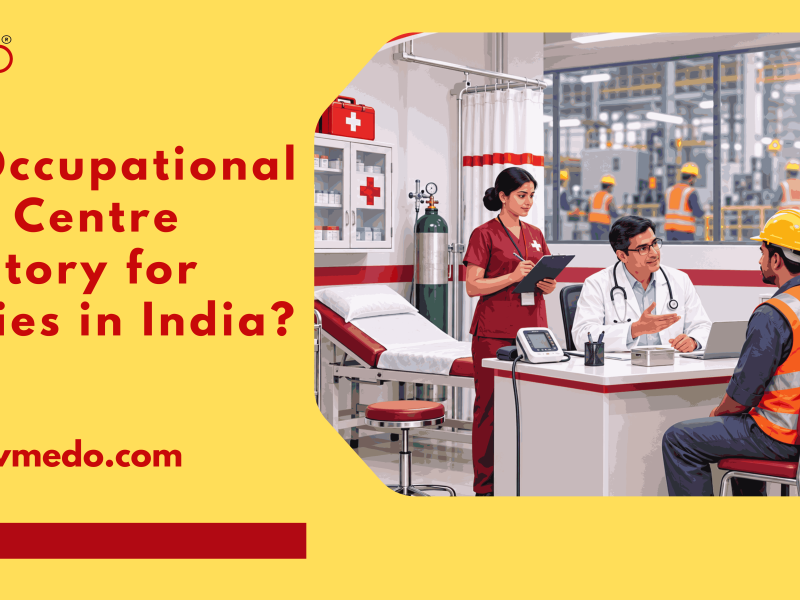
An Occupational Health Centre (OHC) plays an important role in protecting the health and safety of factory workers. From treating minor workplace injuries to responding to medical emergencies, a properly equipped OHC helps factories provide timely medical assistance.
However, setting up an OHC involves more than arranging a medical examination bed and a first aid box. Factories need appropriate medical equipment, emergency response facilities, diagnostic instruments and essential supplies based on their workforce strength and occupational health risks.
In India, the Occupational Safety, Health and Working Conditions (OSHWC) Code, 2020, along with applicable central and state rules, establishes requirements for workplace medical facilities.
This article explains what medical equipment should be available in a factory OHC, how equipment requirements vary across industries, and what employers should consider when setting up an Occupational Health Centre.
What Is an Occupational Health Centre (OHC) in a Factory?
An Occupational Health Centre is a designated medical facility within a factory that provides healthcare support to employees during working hours.
Depending on the workplace and applicable requirements, an OHC may support:
- First aid and immediate medical assistance for workplace injuries.
- Emergency medical assessment and stabilisation.
- Routine employee health monitoring.
- Pre-employment and periodic medical examinations.
- Occupational disease surveillance.
- Medical documentation and employee health records.
The medical equipment available in an OHC should reflect the factory’s activities, potential workplace hazards, workforce strength and medical emergency preparedness requirements.
Essential Medical Equipment Required in a Factory OHC
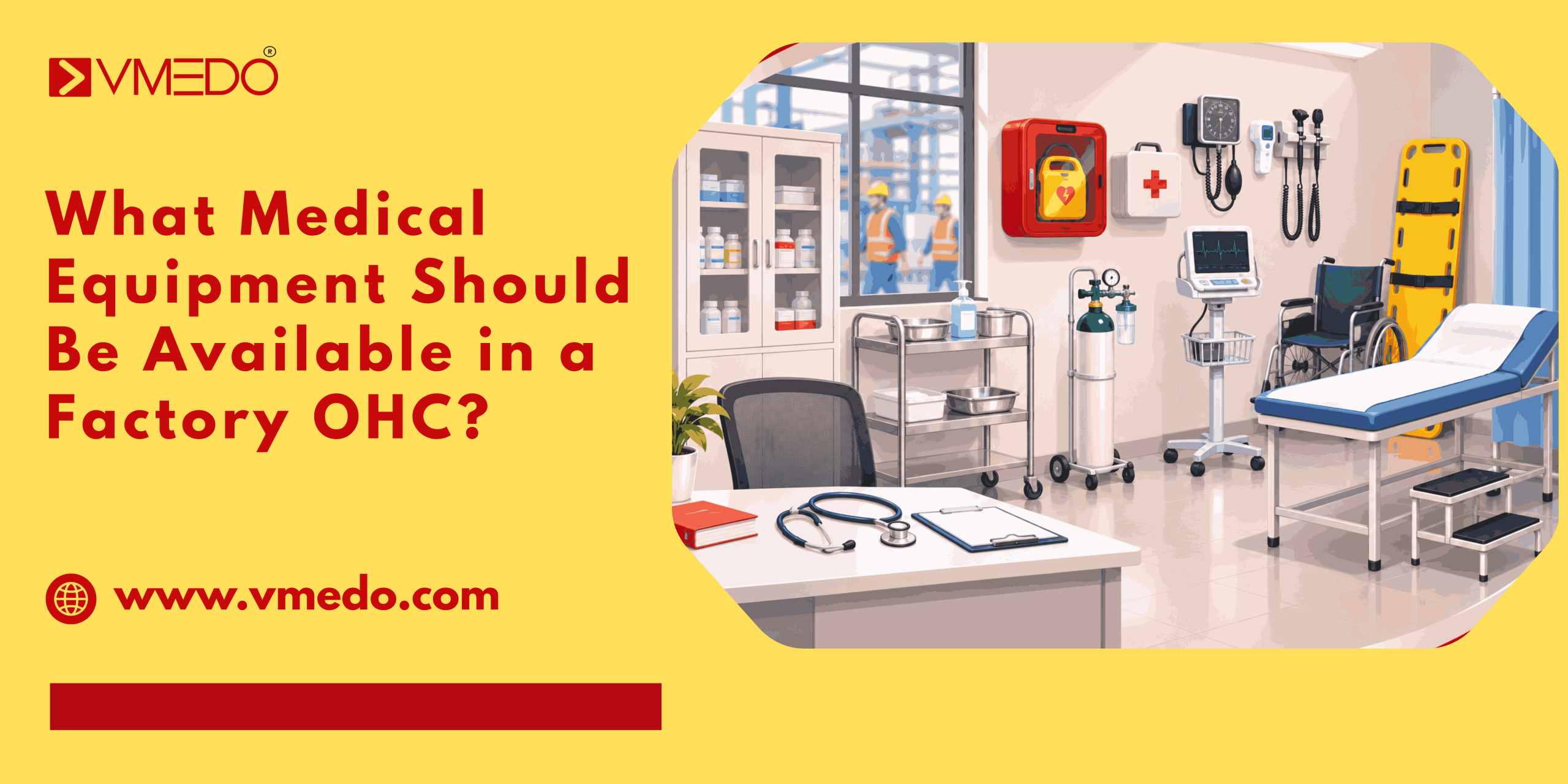
A properly equipped factory OHC generally includes equipment for basic medical examinations, emergency care, injury management and occupational health monitoring.
1. Basic Medical Examination Equipment
Basic medical examination equipment helps healthcare professionals assess employees’ general health and identify medical concerns.
The commonly required equipment includes:
- Stethoscope: For listening to heart and lung sounds during medical examinations.’
- Blood Pressure Monitor: For measuring and monitoring employees’ blood pressure.
- Digital Thermometer: For checking body temperature.
- Pulse Oximeter: For monitoring blood oxygen saturation and pulse rate.
- Glucometer: For measuring blood glucose levels when clinically indicated.
- Weighing Scale: For measuring employee body weight.
- Height Measuring Scale: For recording height and calculating Body Mass Index (BMI).
- Examination Torch: For basic eye, throat and general clinical examinations.
These instruments support routine consultations and help medical professionals assess employees who report health concerns.
2. Emergency Medical Equipment
Factories should prepare for medical emergencies such as cardiac arrest, breathing difficulties, serious injuries and sudden illness.
Depending on the applicable rules and assessed workplace risks, an OHC may require:
- Automated External Defibrillator (AED): Helps trained responders deliver a shock when advised by the device during sudden cardiac arrest.
- Oxygen Cylinder with Flowmeter: Provides supplemental oxygen when clinically indicated.
- Bag-Valve-Mask (Ambu Bag): Supports assisted ventilation by trained healthcare personnel.
- Portable Suction Apparatus: Helps clear secretions from a patient’s airway.
- Emergency Resuscitation Kit: Contains equipment needed for immediate resuscitation.
- Emergency Stretcher: Supports safe movement of injured or unwell employees.
- Wheelchair: Assists employees with reduced mobility.
Medical emergencies require immediate action. Therefore, healthcare personnel should know how to operate the available equipment and follow established emergency response protocols.
3. First Aid and Injury Management Equipment
Workplace injuries such as cuts, burns, fractures and eye injuries can occur in manufacturing and industrial environments.
Accordingly, a factory OHC should maintain suitable first aid and wound management supplies.
Common items include:
- Sterile gauze and wound dressings.
- Roller bandages and crepe bandages.
- Adhesive bandages and medical tapes.
- Antiseptic solutions.
- Burn dressings.
- Medical scissors and dressing forceps.
- Disposable medical gloves.
- Splints for immobilising suspected fractures.
- Eye pads and appropriate eye irrigation supplies.
- Pressure dressings and suitable bleeding-control equipment.
Factories must also maintain appropriately stocked first aid boxes at accessible locations throughout the workplace, according to applicable requirements.
4. Patient Examination and Medical Room Furniture
An OHC needs suitable medical furniture to support examinations, treatment and employee observation.
Common equipment and furniture include:
- Patient examination couch or bed.
- Doctor’s examination table and chair.
- Patient seating arrangements.
- Medical storage cabinets.
- Dressing trolley.
- IV stand.
- Privacy screens or curtains.
- Washable bedding and examination sheets.
- Handwashing facilities.
- Suitable medical waste containers.
The medical room should allow healthcare personnel to examine patients safely while maintaining cleanliness and privacy.
5. Occupational Health Monitoring Equipment
Some factories expose employees to dust, noise, chemicals, fumes, vibration and other occupational hazards.
In such workplaces, the Factory Medical Officer may recommend additional diagnostic equipment for occupational health surveillance.
| Medical equipment | Primary purpose |
|---|---|
| Spirometer / Pulmonary Function Test (PFT) equipment | Assesses lung function in workers exposed to respiratory hazards |
| Audiometer | Evaluates hearing in employees exposed to occupational noise |
| ECG Machine | Records electrical activity of the heart when clinically indicated |
| Vision Screening Equipment | Evaluates visual acuity and other job-relevant vision requirements |
| Peak Flow Meter | Measures peak expiratory flow as an additional respiratory assessment tool |
| Blood Glucose Monitoring Kit | Supports blood glucose testing when medically indicated |
The selection of diagnostic equipment should depend on the factory’s health risk assessment, applicable medical examination requirements and recommendations from qualified healthcare professionals.
Not every factory must purchase every diagnostic instrument. Some specialised tests may be conducted through authorised external medical facilities.
6. Industry-Specific Emergency Equipment
Different manufacturing industries have different occupational health risks. Therefore, factories should consider additional equipment based on the hazards associated with their operations.
| Industry | Additional equipment to consider |
|---|---|
| Chemical and Pharmaceutical Industries | Emergency eyewash stations, safety showers and chemical exposure response supplies |
| Steel and Metal Manufacturing | Burn dressings, trauma supplies and suitable immobilisation equipment |
| Textile Industries | Respiratory assessment equipment and hearing assessment facilities where exposure warrants them |
| Automobile Manufacturing | Trauma management supplies, splints and emergency immobilisation equipment |
| Food Processing Industries | First aid supplies, burn treatment materials and basic examination equipment |
| Cement and Mining Industries | Respiratory monitoring equipment, hearing assessment facilities and emergency trauma equipment |
The Factory Medical Officer should determine additional requirements through a workplace risk assessment and applicable occupational health regulations.
What Does the OSHWC Code Say About OHC Medical Equipment?
The Occupational Safety, Health and Working Conditions Code, 2020, which came into force on 21 November 2025, provides a legal framework for workplace health and safety.
Under the Occupational Safety, Health and Working Conditions (Central) Rules, 2026, Rule 55 addresses ambulance rooms for covered establishments ordinarily employing more than 500 workers.
Annexure II provides an illustrative medical equipment list that includes examination facilities, blood pressure apparatus, oxygen equipment, stretchers, wound management supplies, a glucometer, pulse oximeter, suction equipment, an AED and a bag-valve-mask resuscitator.
For factories in Karnataka, the earlier Karnataka Factories Rules, 1969, particularly Rule 88-M and its equipment schedule, remain important references when assessing hazardous-process OHC requirements.
Karnataka also published draft OSHWC Rules in January 2026. Since draft provisions do not automatically become enforceable requirements, employers should verify the latest notified state rules and applicable transitional provisions before finalising their compliance checklist.
Important: The equipment required for an individual factory depends on its legal coverage, worker strength, hazardous processes and applicable central or state rules. Every item discussed in this blog is not necessarily mandatory for every OHC.
Factory OHC Medical Equipment Checklist
The following checklist can help HR Managers, EHS Officers and Factory Medical Officers review the medical readiness of their Occupational Health Centre.
| Equipment category | Equipment to verify |
|---|---|
| Medical examination | Stethoscope, BP monitor, thermometer, pulse oximeter |
| Emergency care | Oxygen cylinder, AED, Ambu bag, suction apparatus, where required |
| Patient handling | Examination couch, stretcher, wheelchair |
| First aid | First aid boxes, dressings, bandages, splints |
| Diagnostic equipment | ECG, PFT, audiometer and vision screening tools, as applicable |
| Medical furniture | Examination table, storage cabinet, dressing trolley, IV stand |
| Infection control | Handwashing facilities, gloves, appropriate waste bins |
| Emergency supplies | Clinician-approved emergency medicines and medical consumables |
Factories should use this checklist alongside the applicable statutory equipment schedule rather than treating it as a replacement for legal requirements.
How Should Factories Maintain OHC Medical Equipment?
Purchasing medical equipment is only the first step. Regular inspection, maintenance and staff training are equally important to keep an OHC ready for emergencies.
Factory management should ensure that:
- Medical equipment undergoes periodic inspection: Check functionality, condition and manufacturer-recommended maintenance requirements.
- Diagnostic instruments receive appropriate calibration: Maintain calibration and service records for instruments that require them.
- Emergency equipment remains ready for use: Inspect AED readiness indicators, electrodes and batteries, oxygen supplies and suction equipment.
- Medical consumables remain within their expiry dates: Review stock levels and replace expired supplies promptly.
- Qualified personnel manage medicines: Store and administer medicines only under appropriate medical supervision, including compliance with applicable prescription and controlled-drug rules.
- Biomedical waste is handled safely: Follow applicable biomedical waste management requirements.
- Healthcare personnel receive practical training: Ensure staff can safely use the equipment available in the OHC.
Documenting these checks helps factories maintain operational readiness and demonstrate appropriate equipment management during inspections.
Frequently Asked Questions (FAQs)
1. What is the most important medical equipment in a factory OHC?
Commonly important equipment includes a stethoscope, blood pressure monitor, examination couch, first aid supplies, oxygen equipment and patient transportation equipment. Additional emergency and diagnostic devices depend on applicable regulations and workplace risks.
2. Is an AED mandatory in every factory OHC?
An AED is included in the illustrative equipment list for ambulance rooms under the OSHWC (Central) Rules, 2026. However, this does not automatically mean every factory OHC must have an AED. Applicability depends on the relevant regulatory provisions and the factory’s circumstances.
3. Does every factory OHC require an ECG and PFT machine?
Not necessarily. ECG and PFT equipment may be appropriate when the workplace health surveillance programme requires these investigations. Factories can also arrange certain specialised examinations through qualified external diagnostic providers, subject to applicable requirements.
4. Who determines the medical equipment required in an OHC?
The factory occupier and management should determine equipment requirements in consultation with the Factory Medical Officer, EHS team and relevant compliance professionals, using applicable statutory schedules and workplace risk assessments.
A properly equipped Occupational Health Centre is an important part of industrial healthcare and workplace emergency preparedness.
From basic medical examination instruments to emergency resuscitation equipment and specialised occupational health monitoring tools, each item supports a particular healthcare function.
Therefore, factories should develop their OHC medical equipment checklist based on applicable legal requirements, employee strength, manufacturing activities and identified occupational health risks.
Regular maintenance, competent medical personnel and effective emergency response procedures are equally important in keeping an OHC functional.
How VMEDO Supports Factory OHC Setup and Medical Equipment Requirements
VMEDO Healthcare supports factories and industrial organisations with Occupational Health Centre setup, medical equipment procurement, qualified medical staffing and ongoing OHC management.
Our solutions include medical examination equipment, emergency care devices, first aid supplies and occupational health monitoring equipment tailored to workplace requirements.
Explore our Occupational Health Centre Setup and Staffing Services or visit VMEDO Store Medical Equipment to learn more about available solutions.
VMEDO – Occupational Health & Wellness Experts!
Legal References
- OSHWC Code, 2020: Section 24 – Workplace welfare and first aid facilities.
- OSHWC (Central) Rules, 2026: Rule 55 and Annexure II – Ambulance room facilities and equipment.
- Karnataka Factories Rules, 1969: Rule 88-M – Occupational Health Centres and equipment schedule.
- Draft Karnataka OSHWC Rules, 2026: Proposed OHC requirements, subject to final notification and applicability.
Note: Employers should verify the latest applicable state rules, statutory schedules and official notifications before making compliance decisions.