Learn Life-Saving CPR and AED Skills with VMEDO
Imagine being at home when a family member suddenly collapses. They are unconscious and not breathing normally. You call for an ambulance, but what can you do until medical help arrives?
During a cardiac arrest, every second matters. Immediate CPR and early use of an Automated External Defibrillator (AED), when available, can significantly improve a person’s chances of survival.
This is why learning CPR and AED skills is important for individuals, families and employees.
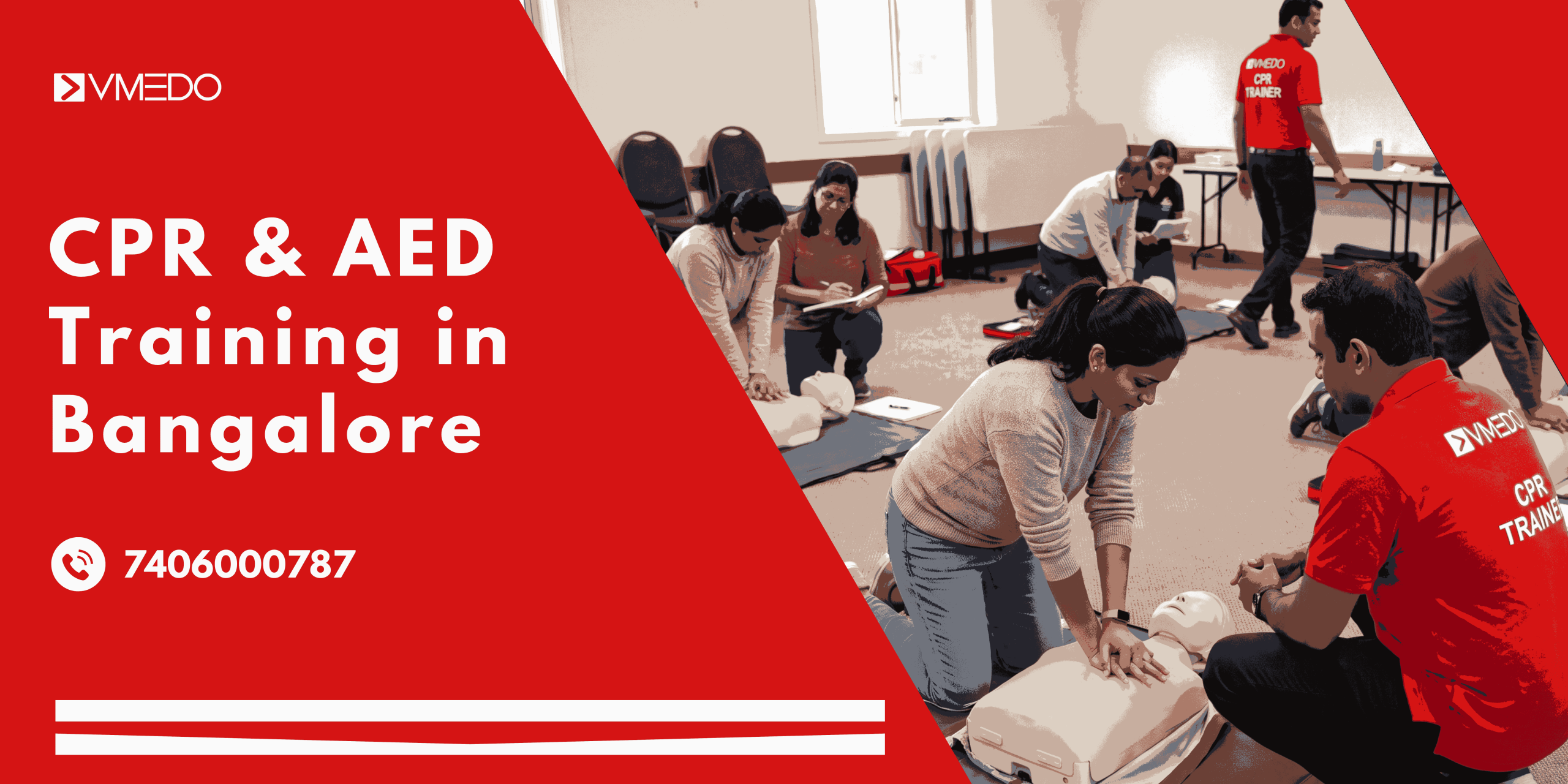
VMEDO offers CPR & AED Training in Bangalore to help individuals and organisations develop essential life-saving skills. Our training programmes focus on recognising cardiac emergencies, understanding CPR techniques and learning how to use an AED during an emergency.
Whether you want to prepare yourself for an unexpected medical emergency or strengthen workplace emergency preparedness, CPR and AED training can help you respond with greater confidence.
What Is CPR?
Cardiopulmonary Resuscitation (CPR) is an emergency life-saving procedure performed when a person is in cardiac arrest.
CPR involves chest compressions, combined with rescue breaths when appropriate, to help maintain blood circulation and oxygen delivery to vital organs.
During cardiac arrest, the heart suddenly stops pumping blood effectively. This prevents oxygen-rich blood from reaching the brain and other vital organs.
CPR helps maintain some blood flow until emergency medical treatment becomes available.
Although CPR does not usually restart the heart, performing it immediately can improve the chances of survival.
What Is Cardiac Arrest?
Cardiac arrest occurs when the heart suddenly stops pumping blood effectively, causing blood circulation to stop.
It may result from dangerous abnormal heart rhythms or other serious medical conditions.
Without immediate treatment, cardiac arrest can lead to irreversible brain injury or death within minutes.
How to Recognise Cardiac Arrest
Common signs include:
- Sudden collapse
- Loss of consciousness
- Unresponsiveness
- Absence of normal breathing
- Abnormal gasping
A person who is unresponsive and not breathing normally should be treated as having a suspected cardiac arrest.
Immediate emergency assistance and CPR are essential.
Cardiac Arrest vs Heart Attack
A heart attack and cardiac arrest are different medical emergencies.
A heart attack occurs when blood flow to part of the heart muscle is blocked or significantly reduced.
A cardiac arrest occurs when the heart suddenly stops pumping blood effectively.
A heart attack can sometimes trigger cardiac arrest, but not every heart attack results in cardiac arrest.
Both conditions require urgent medical attention.
How to Perform CPR During a Cardiac Arrest
Knowing the basic steps of CPR can help you respond when someone experiences a suspected cardiac arrest.
The following steps apply to adults.
Step 1: Check Responsiveness
Ensure the surrounding area is safe.
Tap the person’s shoulders and shout to check for a response.
If the person is unresponsive, call for help and check whether they are breathing normally for no more than 10 seconds.
If they are not breathing normally or are only gasping, suspect cardiac arrest.
Untrained bystanders should not delay CPR by checking for a pulse.
Step 2: Call an Emergency Ambulance
Immediately activate emergency medical services.
In India, dial 112 for emergency assistance.
If someone else is present, ask them to contact emergency services and bring an AED if available.
Follow the emergency dispatcher’s instructions and begin CPR promptly.
Step 3: Start Chest Compressions
Position the person on their back on a firm, flat surface when feasible, without delaying CPR.
Place the heel of one hand in the centre of the chest, over the lower half of the breastbone. Place the other hand on top.
Keep your arms straight and shoulders positioned above your hands.
For adult CPR:
- Compression rate: 100–120 compressions per minute
- Compression depth: At least 5 cm, while avoiding depths greater than 6 cm
- Chest recoil: Allow the chest to return fully after each compression
- Interruptions: Minimise pauses between compressions
Chest compressions help maintain blood circulation to vital organs until further medical treatment is available.
Step 4: Provide Rescue Breaths If Trained
If you are trained and able to provide rescue breaths, conventional adult CPR involves:
30 chest compressions followed by 2 rescue breaths.
Each rescue breath should last approximately one second and produce visible chest rise.
If you are untrained or unable to provide rescue breaths, perform hands-only CPR for an adult or teenager who suddenly collapses.
Hands-only CPR involves continuous chest compressions without rescue breaths.
For infants, children and cardiac arrests associated with drowning or breathing problems, CPR with rescue breaths is particularly important when the rescuer is trained and able to provide them.
Step 5: Use an AED If Available
An AED can help treat certain life-threatening abnormal heart rhythms during cardiac arrest.
Turn on the AED and follow its voice or visual instructions.
Attach the electrode pads to the person’s bare chest as illustrated on the device.
Ensure nobody touches the person during rhythm analysis or shock delivery.
If a shock is advised, follow the device’s instructions.
Resume CPR immediately after the shock or when the AED instructs you to do so.
Continue CPR and follow AED prompts until emergency responders take over, the person shows signs of life, or you cannot safely continue.
What Is an AED?
AED stands for Automated External Defibrillator.
An AED is a portable medical device that analyses the heart’s electrical rhythm during suspected cardiac arrest.
When the device detects a shockable rhythm, it advises an electrical shock that may help restore an effective heart rhythm.
Certain cardiac arrests involve abnormal rhythms such as ventricular fibrillation or pulseless ventricular tachycardia.
An AED can help treat these rhythms through defibrillation.
However, not every cardiac arrest requires or responds to an electrical shock.
AEDs are designed to advise a shock only when the detected rhythm is shockable.
Can Anyone Use an AED?
Yes. AEDs are designed to provide voice or visual instructions that guide users through the emergency response process.
Formal training is not required to use an AED during an emergency.
However, CPR and AED training helps individuals become familiar with the equipment and practise appropriate emergency response techniques.
CPR vs AED: Understanding the Difference
CPR and AED use serve different but complementary purposes during cardiac arrest.
| CPR | AED |
|---|---|
| Helps maintain blood circulation through chest compressions | Analyses the heart’s electrical rhythm |
| Can include rescue breaths | Advises a shock for certain abnormal heart rhythms |
| Can be performed without equipment | Requires an AED device |
| Should begin immediately when cardiac arrest is suspected | Should be used as soon as available |
| Supports circulation until further treatment | Can help restore an effective heart rhythm in shockable cardiac arrests |
Both CPR and AED use are important components of an effective cardiac arrest response.
Why Is CPR & AED Training Important?
Cardiac arrest can happen unexpectedly at home, in schools, workplaces or public spaces.
Family members, colleagues and other bystanders are often the first people available to respond.
Knowing how to recognise cardiac arrest, call for help, perform CPR and use an AED can help reduce delays in providing assistance.
CPR & AED Training help individuals:
- Recognise cardiac arrest and other medical emergencies
- Understand when CPR is required
- Learn appropriate chest compression techniques
- Understand rescue breathing procedures
- Become familiar with AED operation
- Coordinate emergency medical assistance
- Develop confidence in responding to emergencies
Learning these skills can help individuals become better prepared to respond before professional medical help arrives.
What Will You Learn in VMEDO’s CPR & AED Training?
VMEDO’s CPR and AED training programmes focus on developing emergency response knowledge and practical skills.
Depending on the selected course, training may cover the following topics.
1. Recognising Cardiac Emergencies
Understanding the signs of cardiac arrest, checking responsiveness and identifying abnormal breathing.
2. CPR Techniques
Learning chest compression techniques, including hand placement, compression rate, depth and complete chest recoil.
3. Rescue Breathing
Understanding when rescue breaths are appropriate and how they are incorporated into conventional CPR.
4. AED Operation
Learning how an AED works, where to position electrode pads, how to follow its instructions and what safety precautions to take.
5. Emergency Response Coordination
Understanding how to activate emergency medical services and coordinate assistance until trained responders arrive.
Specific course content, practical sessions and assessments depend on the training programme selected.
Why Choose VMEDO for CPR & AED Training in Bangalore?
VMEDO provides First Aid, CPR, AED and emergency response training solutions for individuals and organisations.
Our programmes support emergency preparedness through structured learning and practical skill development.
Frequently Asked Questions About CPR & AED Training in Bangalore
1. Where can I learn CPR and AED in Bangalore?
VMEDO provides CPR, AED, First Aid and BLS training options in Bangalore. Individuals and organisations can enquire about available programmes and registration details.
2. Can anyone learn CPR and AED?
Yes. Basic CPR and AED training is suitable for people without a medical background. Certain advanced or professional courses may have specific eligibility requirements.
3. What is the recommended CPR compression rate?
For adults, the recommended chest compression rate is 100–120 compressions per minute, with a depth of at least 5 cm while avoiding depth
4. Can CPR be performed without rescue breaths?
Yes. Hands-only CPR is appropriate for untrained bystanders responding to an adult or teenager who suddenly collapses and is not breathing normally. Also, you can avoid rescue breaths if you do not know the patient and there is no CPR Mask available to deliver the rescue breath.
5. Can an untrained person use an AED?
Yes. AEDs provide voice or visual instructions to guide users through the process. Formal training is not required for emergency use, although training is recommended.
6. Does an AED always deliver a shock?
No. An AED advises a shock only when it detects a shockable heart rhythm.
7. Is CPR & AED training useful for employees?
Yes. Training can help employees recognise suspected cardiac arrest and provide immediate assistance while professional medical help is being arranged.
8. Does VMEDO provide CPR & AED training certificates?
Yes, certificate availability, issuing organisation, validity and assessment requirements depend on the selected programme. Contact VMEDO for course-specific details.
9. How long does CPR & AED training take?
Training duration varies depending on the course curriculum and practical requirements. VMEDO can provide programme-specific duration and scheduling details.
10. How can companies organise CPR & AED training in Bangalore?
Organisations can contact VMEDO with their participant count, preferred training location and programme requirements to request a quotation.
Medical disclaimer: This article is intended for educational awareness and does not replace hands-on CPR training, emergency dispatcher instructions or professional medical assistance.